We show here some frequently used inequalities which express bounds of one norm of a function (or of a derivative of a function) in terms of other norms of the same function and its derivatives. Typical examples are so-called Sobolev inequalities which give bounds of the maximum norm of a function in terms of L 2-norms of derivatives. It is important that the constants entering these estimates do not depend on any specific function under consideration, but are uniform for a certain class of functions.
To derive such estimates, we may always assume the functions to be C ?- smooth, for convenience. (The functions take values in C n.) Then the estimate extends to all (less smooth) functions which can be approximated by C ?-functions w.r.t. the norms entering the estimate.
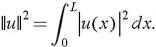
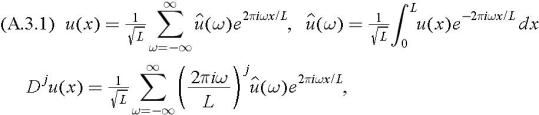
L 2-estimates of periodic functions. Let u ? C ? (R), u(x) ?u(x+L); i.e., u is L-periodic. As usual,
We first show
Lemma A.3.1. For all ?>0 and all integers j, k ?1 it holds that
Proof. By Fourier expansion,
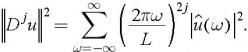
and Parseval s relation yields that
Therefore, the lemma is proved if we can show that
The function
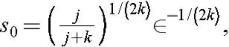
has its minimum at
and
Hence the assertion follows.
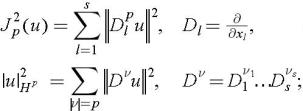
A generalization to any number of space dimensions is straightforward. Let u ? C ?( R s) be L-periodic in each variable x l, and denote
We use the notations
i.e.,
Copyright The Society for Industrial and Applied Mathematics 2004 under license agreement with Books24x7

 TABLE OF CONTENTS