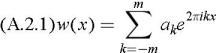
Fourier interpolation in 1D. Let m ?{1, 2, }, h=(2 m+1) ?1, x ?= ?h, ?=0, 1, 2, Suppose that ?(x) is a 1-periodic function, ?(x) ??( x+1), defined at all gridpoints x=x ? . We want to interpolate ?(x) by a Fourier polynomial
at all grid points:
Theorem A.2.1. The interpolation problem (A.2.2) has a unique solution (A.2.1).
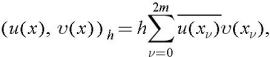
Proof. If we introduce the inner product
then the gridfunctions
form an orthonormal system, i.e.,
The above result is obvious for k= l and follows from the geometric-sum formula otherwise. Consequently, if w(x) is an interpolant of the form (A.2.1), then
Thus the coefficients a l are uniquely determined by the data function ?(x). Also, we can consider the interpolation-condition
as a linear system of 2 m+1 equations for the 2 m+1 unknown a k. Since the solution vector is unique (if it exists), the system-matrix is nonsingular, and existence follows.
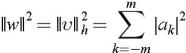
Fourier interpolation is very useful since the interpolant w(x) inherits smoothness from the data ?(x), with estimates independent of h. More precisely, if we introduce norms by
then the following result holds:
Theorem A.2.2. If w(x) denotes the Fourier interpolant of the data ?(x) then
and
It is important that the factor ( ?/2) 2 p does not depend on h.
Proof.
Copyright The Society for Industrial and Applied Mathematics 2004 under license agreement with Books24x7


 TABLE OF CONTENTS