7.8. Semibounded Operators
In the previous sections we have considered differential equations
in the strip 0 ? x ?1, t ?0, together with an initial condition
and boundary conditions. Restricting ourselves to the homogeneous time independent case, we write the boundary conditions in the form
Here we assume that L j is a linear operator which combines values of u and its spatial derivatives evaluated at (x, t)= (j, t), j=0,1. In most cases our proofs of an energy estimate followed from an inequality of the type
Thus the critical question is whether we can show an estimate
if u satisfies the boundary conditions.
We shall now formalize the procedure to some extent. For every fixed t the differential expression
defines an operator P t if we specify its domain of definition D. Let us define
i.e., D consists of all C ?-functions which satisfy the boundary conditions. The following definition formalizes our requirement:
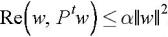
Definition 1. We call the operators P t , t ?0, semibounded on D if there exists a constant ? such that
for all t ?0 and all w ? D.
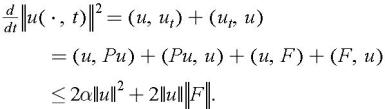
Clearly, if the operators P t are semibounded on D and if the strip problem has a solution u with u( , t) ? D for each t, then our considerations show
Thus uniqueness and the basic energy estimate follow.
One...

 TABLE OF CONTENTS