An Introduction to Ordinary Differential Equations
Part I: First Order Differential Equations

Chapter List

Chapter 1: Radioactive Decay and Carbon Dating
Chapter 2: Integration Variables
Chapter 3: Classification of Differential Equations
Chapter 4: *Graphical Representation of Solutions Using MATLAB
Chapter 5: Trivial Differential Equations
Chapter 6: Existence and Uniqueness of Solutions
Chapter 7: Scalar Autonomous ODEs
Chapter 8: Separable Equations
Chapter 9: First Order Linear Equations and the Integrating Factor
Chapter 10: Two Tricks for Nonlinear Equations

Before we start our formal treatment of the subject we will look at a very simple example that nonetheless exhibits the power of differential equations as models of reality. One point to bear in mind in this chapter is the distinction to be made between finding the solution of a differential equation, and interpreting this solution.

1.1 Radioactive Decay

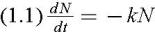
Let N( t) denote the number of radioactive atoms in some sample of material at time t. Then with k < 0 the equation


is a very good model for the way that the number of radioactive atoms decays (see Exercise 1.1).

Although we will see later how to solve this equation, for now we will assume that when there are N s isotopes at time s, the solution is


You can check that we really do have the solution: when t = s the formula in (1.2) gives N( s) = N s, while we have


and so the differential equation (1.1) is satisfied.

It follows from (1.2) that the number of radioactive isotopes decays exponentially...

UNLIMITED FREE
ACCESS
TO THE WORLD'S BEST IDEAS

SUBMIT
Already a GlobalSpec user? Log in.

This is embarrasing...

An error occurred while processing the form. Please try again in a few minutes.

Customize Your GlobalSpec Experience

Category: DNA Sequencers
Finish!
Privacy Policy

This is embarrasing...

An error occurred while processing the form. Please try again in a few minutes.