An Introduction to Ordinary Differential Equations
Appendix C: Derivatives and Partial Derivatives

This appendix covers the definitions and properties of ordinary and partial derivatives, Taylor expansions in one and two variables, and some properties of the critical points (turning points) of functions.

Functions of One Variable: Ordinary Derivatives

We start by considering functions f( x) of one variable, and their derivatives.

Definition and properties of the derivative

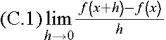
Let I be an interval. A function f : I ? is differentiable at a point x ? I if the limit


exists, in which case the limit in (C.1) is the derivative of f at x, which we write as (d f/d x)( x) or f ?( x).

This basic definition implies the standard rules of differentiation. The product rule is


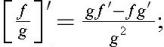
the quotient rule is


and the chain rule, which allows us to differentiate functions of functions, is [1]


Taylor expansions

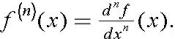
Taylor s Theorem allows us to expand a function f as a power series about a point x 0 using its derivatives. Suppose that f has n + 1 derivatives, all of which are continuous functions, and that we use the notation


Then we can write


for some point y n ? ( x 0, x).

Provided that the remainder term


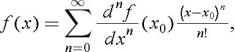
tends to zero as n tends to infinity, we can write f( x) as the power series


known as the Taylor expansion or Taylor series for f .

UNLIMITED FREE
ACCESS
TO THE WORLD'S BEST IDEAS

SUBMIT
Already a GlobalSpec user? Log in.

This is embarrasing...

An error occurred while processing the form. Please try again in a few minutes.

Customize Your GlobalSpec Experience

Category: Flow Controllers
Finish!
Privacy Policy

This is embarrasing...

An error occurred while processing the form. Please try again in a few minutes.