An Introduction to Ordinary Differential Equations
All the equations that we have considered so far have been first order equations in which there was only one dependent variable (e.g. x( t) or y( x), where x and y are scalars). If we were restricted to equations in which there is only one dependent variable then this would exclude the vast majority of applications: for example, specifying the position of something in the three-dimensional space in which we live requires three coordinates.
Although it is much harder to find solution methods for equations involving a number of dependent variables, the theoretical ideas are straightforward generalisations of what we did for scalar equations in Chapter 6. Here we make precise what we mean by a solution, and state the theorem that guarantees the existence and uniqueness of solutions under easily checked conditions.
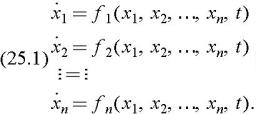
Suppose that we have n dependent variables x 1, , x n, and each of these obeys a differential equation with the right-hand side (perhaps) depending on some of the other variables,
This is a set of n coupled first-order equations which we can...