An Introduction to Ordinary Differential Equations

Part II: Second Order Linear Equations with Constant Coefficients

Chapter List

Chapter 11: Second Order Linear Equations General Theory
Chapter 12: Homogeneous Second Order Linear Equations with Constant Coefficients
Chapter 13: Oscillations
Chapter 14: Inhomogeneous Second Order Linear Equations
Chapter 15: Resonance
Chapter 16: Higher Order Linear Equations with Constant Coefficients

We will now turn to second order differential equations,


In this chapter we address the kinds of theoretical question that we covered for first order equations in Chapter 6. As such there are few examples, but we will return to more concrete problems and solution methods in the next chapter.

11.1 Existence and Uniqueness

First we discuss the existence and uniqueness of solutions. Before we do this formally, we give an indication of why we will need to specify both x and in our initial condition .

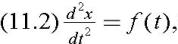
Consider the simplest type of second order equation,


the second order equivalent of the trivial equations we considered in Chapter 5. We can solve (11.2) by integrating twice: if F is any anti-derivative of f then


and then if is any anti-derivative of F


The two integrations result in two arbitrary constants ( c 1 and c 2); specifying x( t 0) alone will not be enough to tie down the solution, but we need to specify ( t 0) (to fix c 1) and then x( t 0) (to determine c 2).

To put this in a physical context, equation (11.2) is the equation of motion for a...

UNLIMITED FREE
ACCESS
TO THE WORLD'S BEST IDEAS

SUBMIT
Already a GlobalSpec user? Log in.

This is embarrasing...

An error occurred while processing the form. Please try again in a few minutes.

Customize Your GlobalSpec Experience

Category: IC Electronic Filters
Finish!
Privacy Policy

This is embarrasing...

An error occurred while processing the form. Please try again in a few minutes.