An Introduction to Ordinary Differential Equations

Chapter 36: *Periodic Orbits

We have already seen that showing the existence of periodic solutions is much more difficult than showing that there are stationary points, and that the joining up of trajectories that is required for a periodic orbit is a sensitive thing. In this brief chapter we look at two results, one that excludes the possibility of there being any periodic orbits, and one guaranteeing that there is at least one.

36.1 Dulac s Criterion

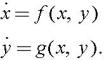
Dulac s criterion is a way of showing that there cannot be any periodic orbits within some region of the phase space. Suppose that we are considering trajectories of the differential equation


Then given a region ? ? , if we can find a smooth function h( x, y) such that


for all x, y ? ? then there are no periodic orbits contained wholly within ?. The proof is straightforward, but relies on the divergence theorem. [1]

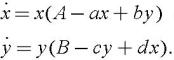
For example, we can easily show that for many choices of parameters there are no periodic orbits in the ecological models


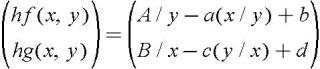
We will suppose that a, c > 0, but will say nothing about A, B, b and d. If we choose h( x, y) = ( xy) ? 1 then


and


Since a, c > 0 there can be no periodic orbits in the region x, y > 0, since this expression is always negative there.

[1] In the divergence theorem says that if

UNLIMITED FREE
ACCESS
TO THE WORLD'S BEST IDEAS

SUBMIT
Already a GlobalSpec user? Log in.

This is embarrasing...

An error occurred while processing the form. Please try again in a few minutes.

Customize Your GlobalSpec Experience

Category: Satellites
Finish!
Privacy Policy

This is embarrasing...

An error occurred while processing the form. Please try again in a few minutes.