An Introduction to Ordinary Differential Equations

Chapter 34: Newtonian Dynamics

In this chapter we apply phase plane ideas to various one-dimensional systems that model a particle moving under Newton s laws of motion. First we consider systems in which the energy is constant, and then we consider systems in which there is some dissipation.

34.1 One-Dimensional Conservative Systems

We consider a particle of mass m moving on a line in a potential force field, such that its potential energy at position x is given by V ( x). Then its kinetic energy is 1/2 m 2, and its total energy is


If the energy is conserved then we can differentiate to give


provided that ? 0 we can cancel this term and obtain [1]


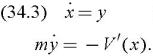
By setting y = , we can rewrite this as the coupled system


In all that follows we will take m = 1 for simplicity.

If you think of these equations as describing the motion of a bead sliding on a wire whose height at coordinate x is given by V ( x) you will get the correct qualitative idea of how the solutions should behave, although this interpretation is not entirely accurate, as discussed in the next section.

Because of the relatively simple form of these equations the possible behaviour of the solutions is restricted. First, note that at any stationary point ( x* , y*) we must have y* = 0 (zero velocity), and x* must be a turning point...

UNLIMITED FREE
ACCESS
TO THE WORLD'S BEST IDEAS

SUBMIT
Already a GlobalSpec user? Log in.

This is embarrasing...

An error occurred while processing the form. Please try again in a few minutes.

Customize Your GlobalSpec Experience

Category: Linear Slides and Linear Stages
Finish!
Privacy Policy

This is embarrasing...

An error occurred while processing the form. Please try again in a few minutes.