Mechanical Alloying: Fundamentals and Applications

Mechanical alloying enables the effective superimposition of numerous strengthening factors including:
oxide dispersion
carbide dispersion
fine grain
high dislocation density and substructure
solid solution strengthening
Both direct and indirect effects influence the mechanical properties of these materials. The interaction of the second phase particles with dislocations is an example of a direct effect, while grain morphology and texture are both indirect effects.
Moreover, the aforementioned five strengthening contributions can be augmented by precipitation strengthening as well as intermetallic dispersion strengthening. Thus, the resulting enhancement in mechanical properties of MA materials is far greater than can be achieved by conventional methods or say by the 'rule of mixture'.
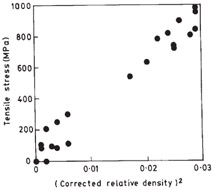
The tensile strength of MA materials is found to be relatively proportional to the square of relative density [1] and is consistent with the density-tensile strength relationship for PM materials (Fig. 8.1):
| (8.1) | |
where ? u is the tensile strength, k m is the material constant, ? is the density and C is a correction factor, equal to green density which represent the state of zero tensile strength.
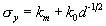
The yield strength of MA materials is found to depend linearly on the inverse of the square root of the grain size (Fig. 8.2) ( i.e. Hall-Petch relationship), even in the case of nanograin materials [1,2,3]:
| (8.2) | |
where ? y is the yield strength, k m is a material constant, k 0