Mechanical Alloying: Fundamentals and Applications

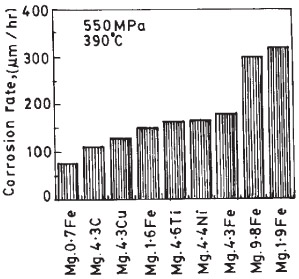
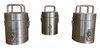
The MA process has been used to alloy magnesium with Fe/Cu/Cr/C/Ti for developing 'supercorroding' alloys, which are used for making links with precisely controllable corrosion rates for releasing deep sea equipment at specific depths [17]. Such supercorroding alloys have also been of use in other submarine applications, such as a heat source in diver suits and as a hydrogen gas generator. The advantage of MA in producing a supercorroding alloy is the extent of control afforded by the closeness of the anode/cathode metals achieved. By adjusting the alloy composition, the reaction rates can be precisely controlled in the device (Fig. 12.18).
Mg-M is a promising system for hydrogen storage. One of the ways to kinetically improve magnesium-based hydrogen storage material is by the addition of metals and alloys whose hydrides have a high dissociation tension. By alloying with catalyst elements/intermetallic compounds, the hydrogenation capability of magnesium is substantially enhanced [17]. The additions include elements such as:
Ni, Ce, La which can be alloyed with Mg conventionally. These hydride-forming elements can function as 'hydrogen pumps' owing to stoichiometric variation.
Elements such as Fe, Co, Ti, Nb that do not normally alloy but form intermetallics with magnesium which can absorb and deabsorb hydrogen.
Intermetallics such as LaNi 5, Mg 2Cu, CeMg 12 and even oxides such as TiO 2.
These are generally prepared by argon...