Mechanical Alloying: Fundamentals and Applications

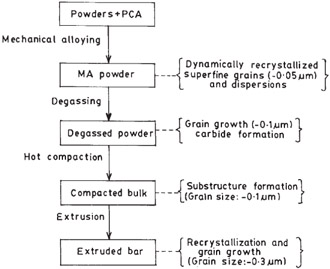
The MA process can be applied to aluminium-base systems provided that organic process control agents are used to control the extreme tendency of aluminium to weld to itself during high energy milling. All MA aluminium products have highly uniform dispersion of equiaxed oxide (Al 2O 3) and carbide (Al 4C 3) particles, formed due to the reaction of aluminium with oxygen and carbon (formed as residue of PCAs) particles during the consolidation. These dispersoids of extremely fine sized oxide and carbide particles (30 40 nm) stabilise a very fine equiaxed grain (0.2 to 0.5 nm) and dislocation substructure during thermomechanical processing [10]. In addition to the strengthening caused by these finely dispersed oxides and carbides, a significant part of the strengthening in these alloys is due to the fine grain size and high dislocation density resulting from the severe working of the powders. Further benefits can be obtained in these alloys by adding small amounts of carbide-forming elements such as titanium. A typical flow sheet for processing MA aluminium alloys is shown in Fig. 12.8 [11]. The development of MA aluminium alloys can be put into three classes: high strength alloys, low density alloys and high temperature alloys.
The major application of MA aluminium alloys is at ambient temperatures rather than elevated temperatures. One example is IN 9052 (Al-4% Mg-1.1% C-0.8% O) (Fig. 12.9). Although a solid solution alloy,...