Mechanical Alloying: Fundamentals and Applications

The use of the SSE to produce supersaturated solutions without producing a second phase can be achieved by various techniques like: solid state quenching, rapid solidification, condensation from the vapour state and irradiation/ion implementation. Supersaturated solid solutions are stronger and harder than equilibrium solid solutions, and on decomposition can produce a higher volume fraction of fine second phase particles. The actual values for the SSE are calculated using Vegard's law, which states that the lattice parameter and the amount of solute added to the solvent lattice have a direct, linear relationship. The technique of MA has been applied for the SSE in a variety of systems as discussed below.
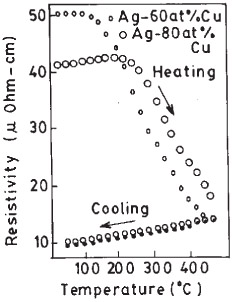
A non-equilibrium supersaturated fcc solid solution is formed in an Ag-Cu system in which the entire composition range has positive heat of mixing and is immiscible to each other by MA [34]. The supersaturated solid solution formation in this system means the elevation of free energy caused not only by the stored energy as defects but also by the effect of mixing of immiscible materials in dimensions as fine as that of a nanometer order. Decomposition of the supersaturated solid solution in MA alloy takes place at above 157 C which can be identified by the accompanied sharp decrease in electrical resistivity (Fig. 12.20). At the initial stage of decomposition, the grain size of the decomposed phases remains at nanometer size. Upon heating above about 327 C grain growth takes place.