Mechanical Alloying: Fundamentals and Applications

Despite the degassing of MA powders prior to their consolidation, MA products still contain gaseous components which impair the joining of these materials. Various potential joining techniques applicable to MA materials are described here.
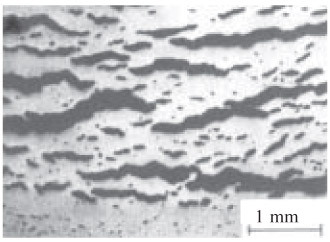
In general, fusion welding is not suitable for joining MA materials. This technique causes the dispersoid particles to be rejected from the molten metal and the development of a high level of porosity in the weld zones due to excessive degassing (Fig. 10.1) [1]. Nevertheless, sound TIG welds suitable for positioning or non load-bearing joints can be made. Fusion welding processes, which minimize the size of the molten zone, produce relatively sound welds. Spot and resistance seam welds with excellent tensile strength can be made. However, it may never be possible to achieve the full stress rupture properties of the base material.
Solid state welding techniques, friction welding, diffusion welding, explosive welding and magnetostrictive welding have demonstrated sound weld joints [2]. Figure 10.2 shows the microstructure of a Dispal/Dispal friction weld made by using a continuous drive type friction welding machine [1]. During the process, one of the components is held stationary, while the other one is rotated at a constant speed (Fig. 10.3). As the two surfaces continue to rub against each other, heat is generated at the interface. After...