Mechanical Alloying: Fundamentals and Applications

12.10: SUPERPLASTICITY

12.10 SUPERPLASTICITY

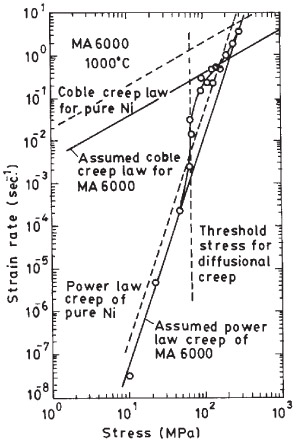
The MA 6000 oxide dispersion-strengthened, nickel-base superalloy has been found to possess superplasticity at 1000 C [46]. In the hot-extruded and hot-rolled condition, i.e. prior to zone annealing, the material has a grain size of 0.26 ?m and a dislocation density of 3 10 9 cm -2. It can be believed that at least some of the ?' is evenly distributed as very fine ( ?30 nm) particles (Fig. 12.2, a similar micro structure, may be referred). The alloy exhibits superplasticity, having a maximum elongation of over 300% and a maximum strain rate sensitivity of 0.47. Transmission electron microscopy shows no evidence of ordinary recrystallization and grain growth is slight. However, strain rates of less than about 1.0 sec -1 alter the initial microstructure and prevent grain coarsening on subsequent annealing at higher temperatures. Deformation of the fine grained MA 6000 can be described as a combination of power law creep and diffusional (Coble) creep [47] (Fig. 12.24). With a threshold stress caused by the presence of ?' particles, it exhibits only the diffusional creep process. Threshold stresses for dislocation creep are not observed.


Figure 12.24: Comparison of the flow data for MA 6000 at 1000 C with the predicted dislocation and Coble creep behaviour of Ni (Ref. 47, Met. Trans., 16A, 777 (1985) (The Minerals, Metals and Materials Society)).

Superplasticity has also been observed in MA IN 90211 aluminium alloy (Al-2%Mg-4.4%Cu-1.1%C-0.8%O) at 447 C and a strain rate of 1.0 sec -1

UNLIMITED FREE
ACCESS
TO THE WORLD'S BEST IDEAS

SUBMIT
Already a GlobalSpec user? Log in.

This is embarrasing...

An error occurred while processing the form. Please try again in a few minutes.

Customize Your GlobalSpec Experience

Category: Thermomechanical Simulation Equipment
Finish!
Privacy Policy

This is embarrasing...

An error occurred while processing the form. Please try again in a few minutes.