Mechanical Alloying: Fundamentals and Applications

12.8: MAGNETIC MATERIALS

12.8 MAGNETIC MATERIALS

Nd-Fe-B Magnets

The advent of high-performance permanent magnets based on Nd-Fe-B in 1983 has generated a huge scientific and technological interest. The main reason for this trend is the cheapness and abundance of the involved elements. The origin of the best magnetic properties in these magnets is the tetragonal structure of Nd 2Fe 14B phase. The Curie temperature ( T c) of these magnets is 314 C which can be improved by a small addition of cobalt. An anisotropic field H A of about 6000 kA/m enables high coercivities (800 to 200 kA/m) and a saturation magnetization of 5120 mA/m.

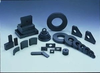
An MA technique using a planetary mill has been recently used to produce isotropic and anisotropic Nd-Fe-B magnets [37]. The MA produces a closely mixed powder of Nd, Fe and B, which has low coercivity due to the presence of ?-Fe magnetic phase which is transformed to hard magnetic Nd 2Fe 14B phase by a solid state reaction by an annealing treatment typically at 700 C for 30 min. These isotropic microcrystalline powders are used for making bonded type isotropic and compacted anisotropic magnets (Fig. 12.21). Compaction is carried out by hot pressing at 700 C for 5 min under a pressure of 1 kbar. Density levels of 98% of theoretical values could be obtained using the process of die upsetting where a hot pressed sample is uniaxially compressed to half its height in a die whose diameter is ?2 times the...

UNLIMITED FREE
ACCESS
TO THE WORLD'S BEST IDEAS

SUBMIT
Already a GlobalSpec user? Log in.

This is embarrasing...

An error occurred while processing the form. Please try again in a few minutes.

Customize Your GlobalSpec Experience

Category: Rare-Earth Magnets
Finish!
Privacy Policy

This is embarrasing...

An error occurred while processing the form. Please try again in a few minutes.