Mechanical Engineering Problems and Solutions, 6th Edition
With this guide, you'll hone your problem-solving skills as well as your understanding of both fundamental and more difficult topics for the Professional Engineering exam.
 TABLE OF CONTENTS
 Statics is that part of engineering mechanics in which a study is made of force systems, equivalent force systems and the external effects that these forces produce on bodies which are at rest or moving with constant velocity. These external effects are usually referred to as reactive forces or just reactions; and the forces that cause them are called active forces or just loads. Some examples of these loads on a vehicle are the weight of the vehicle, the weight of the occupants, and the air resistance. Bodies which are at rest or moving with constant velocity have their active and reactive force systems in equilibrium which means no resultant force or no resultant moment. In solving for the reactive forces a very useful visual aid is a diagram of the structure or a member of the structure in which all the forces applied by contacting bodies plus gravity forces (weight) are shown; this diagram is called a "free body diagram".
The principles used in statics are as listed below:
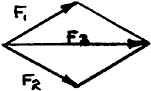
Parallelogram Law -
Forces F 1 and F 2 can be replaced by F 3, i.e., diagonal of parallelogram through point of concurrency of F 1 and F 2.
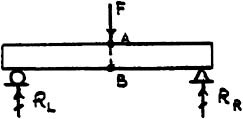
Principle of Transmissibility -
External effects, i.e., reactions R L and R R are not changed by moving Force F from A to B or to any point on its line of action.
Newton's 1st Law -
Contains principle of...