Mechanical Engineering Problems and Solutions, 6th Edition
With this guide, you'll hone your problem-solving skills as well as your understanding of both fundamental and more difficult topics for the Professional Engineering exam.
 TABLE OF CONTENTS
 Dynamics is that part of engineering mechanics in which a study is made of particles and bodies in motion; it is divided into branches-namely, kinematics and kinetics. Kinematics consists essentially of deriving equations relating to displacement, velocity, acceleration and time. Kinetics consists essentially of deriving equations relating to the unbalanced force or the unbalanced moment to the change in motion.
Kinematics:
Types of particle motion -
Rectilinear motion
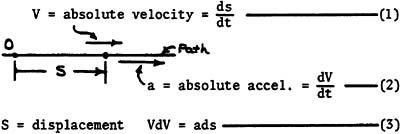
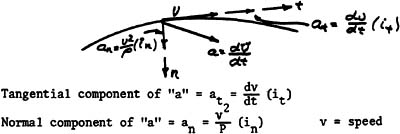
Curvilinear motion
Types of Rigid Body Plane Motion:
Rectilinear Translation - all particles move on parallel straight lines and have same displacements, velocities and accelerations.
Curvilinear Translation - same as above except that all particles move on congruent curves.
Fixed Axis Rotation - all particles move on concentric circular paths
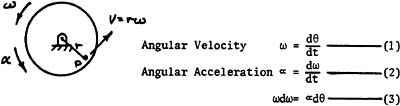
For Particle P -
Tangential acceleration of particle 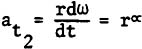
Normal acceleration of particle 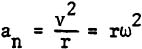
General Plane Motion - a motion which can be resolved into translation plus fixed axis rotation

Kinetics:
Newton's 2nd Law of Motion for a particle-

F = unbalanced force
m = mass of particles
a = absolute acceleration
For English Gravitation System of Units-

For a system of particles (rigid or non-rigid body)-

F = unbalanced force
M = mass of system of particles
a = absolute acceleration of center of mass
For rigid-body rotation about fixed axis
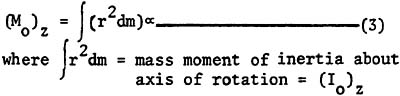
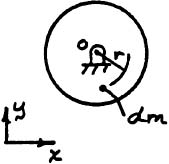
(M o) z = (I o) z ?
where ?(M o) z is unbalanced moment about axis of rotation
Work Energy Principle
By taking Newton's 2nd Law of Motion and using components...