Mechanical Engineering Problems and Solutions, 6th Edition
With this guide, you'll hone your problem-solving skills as well as your understanding of both fundamental and more difficult topics for the Professional Engineering exam.
 TABLE OF CONTENTS
 In the preceding section we saw that money at different points in time (for example, $100 today or $100 one year hence) may be equal in the sense that they both are $100, but $100 a year hence is not an acceptable substitute for $100 today. When we have acceptable substitutes, we say they are equivalent to each other. Thus at 8% interest, $108 a year hence is equivalent to $100 today.
At a 10% per year (compound) interest rate, $500 now is equivalent to how much three years hence?
Solution
$500 now will increase by 10% in each of the three years.
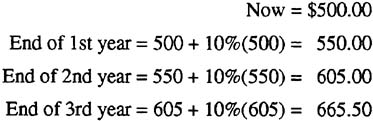
Thus $500 now is equivalent to $665.50 at the end of three years. Note that interest is charged each year on the original $500 plus the unpaid interest. This compound interest computation gives an answer that is $15.50 higher than the simple interest computation in Example 2.
Equivalence is an essential factor in engineering economics. Suppose we wish to select the better of two alternatives. First, we must compute their cash flows. For example
| Alternative | ||
|---|---|---|
| Year | A | B |
| 0 | ?$2000 | ?$2800 |
| 1 | +800 | +1100 |
| 2 | +800 | +1100 |
| 3 | +800 | +1100 |
The larger investment in Alternative B results in larger subsequent benefits, but we have no direct way of knowing whether it is better than Alternative A. So we do not know which to select. To make a decision, we must resolve the alternatives into equivalent