Mechanical Engineering Problems and Solutions, 6th Edition
With this guide, you'll hone your problem-solving skills as well as your understanding of both fundamental and more difficult topics for the Professional Engineering exam.
 TABLE OF CONTENTS
 Ventilation of an enclosed space is usually for the purposes of controlling the air temperature, humidity, and/or chemical composition. When humans occupy the space (room), the ventilation is necessary to provide adequate breathing oxygen and to transport the waste heat and moisture produced by the occupants. Normally, the waste heat and moisture far exceed the breathing oxygen ventilation requirement.
The heat and moisture release rates by the occupants are functions of their activity level, age, size, and sex. The fraction of energy associated with heat transferred to the air by convection and surrounding surfaces by radiation is called sensible heat while that associated with moisture evaporation is called latent heat. These fractions vary, depending on activity level and environmental state. In addition to the occupant heat and moisture load there may be an equipment and lighting load ventilation requirement.
It is normally assumed that the room air is homogeneous and is the same as the room air exhaust state.
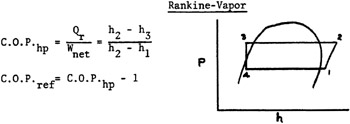
Basic Refrigeration Cycles:
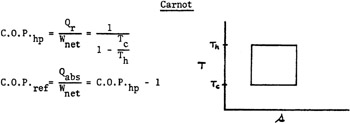
Reference - ASHRAE Handbook of Fundamentals.
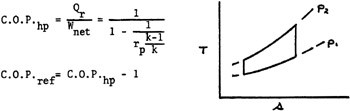
Gas Compression-Expansion Refrigeration Cycle:
Human Factors and Constants:
| Sedentary heat output rate | - 400 Btu/hr-person |
| Normal sedentary fresh air requirement | - 10 cfm/person |
| Minimum fresh air breathing requirement | - 3 cfm/person |
| Nominal comfort state (q s/q ? ? 3) | - 75 F db 60 F wb |
| c,c p, c v | - specific heats | |
| C.O.P. hp | - coefficient of performance of a heat pump | |
| C.O.P. ref | - coefficient of performance of a refrigerator |