Mechanical Engineering Problems and Solutions, 6th Edition
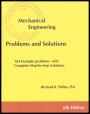
With this guide, you'll hone your problem-solving skills as well as your understanding of both fundamental and more difficult topics for the Professional Engineering exam.
 TABLE OF CONTENTS
 This chapter is arranged to present typical Professional Engineering examination problems. Some will be preceded with an explanation, while in other cases only the problem and solution will appear. If there are solutions that are not clear, an excellent text on this subject is Mechanical Engineering Design by Shigley (published by McGraw-Hill). The references in this chapter are to the Fourth Edition.
The order of the chapter will be by problem type: Bolted Joints, Bearing and Shaft Loads, Interference Fits, Size of Shafts and Critical Speeds, Mechanisms, Gear Trains, Miscellaneous Problems.
Bolted joints that are loaded eccentrically may be analyzed by dividing the load per bolt into two components, one the direct shear and the second the moment load or secondary shear. The assumptions for bolted joints are that (a) none of the load is taken in friction between the two members, and (b) that the moment load on a bolt is directly proportional to its distance from the centroid of the bolt pattern.
To solve an eccentrically loaded bolted problem one may divide the load by the number of bolts to obtain the direct shear load per bolt, then determine the proportionality factor for obtaining the secondary shear force per bolt. This proportionality factor may be determined by solving the equations relating to the force per bolt and the distance to the centroid of the bolt pattern. Thus, F b = rk, where F b is the force on the bolt, r...