Mechanical Engineering Problems and Solutions, 6th Edition

With this guide, you'll hone your problem-solving skills as well as your understanding of both fundamental and more difficult topics for the Professional Engineering exam.
 TABLE OF CONTENTS
 A fluid continuously deforms when subjected to shear forces. Therefore, if a fluid is at rest of if it moves as a rigid body, there can be no shear stresses within or on the boundaries of the fluid. The differential equation of the pressure field is then given by

p = pressure
? = ?g = specific weight (i.e., weight density; ? is mass density)
a x, a y, a z = components of acceleration
g = gravitational force per unit mass
z-axis is parallel to  but directed upward
If the density and acceleration are uniform throughout the body of fluid under consideration, the above equation is easily integrated to give the pressure distribution. For the important special case in which the density is uniform and the acceleration is zero, the pressure distribution is given by
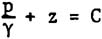
C is a constant that can be evaluated if the density is known and the pressure is known at some reference elevation. From the pressure distribution the resultant force on a submerged surface can readily be determined by applying the principles of statics for distributed loads. The difference in pressure between discrete points in the fluid can also be determined and is important in instrumentation problems.

When a fluid flows, shear stresses are produced within the fluid and at the boundaries. However, there are many important problems in which the effect of the shear stresses can be neglected. This...