Mechanics of Materials

Chapter Six: Symmetric Bending of Beams

6.0 OVERVIEW

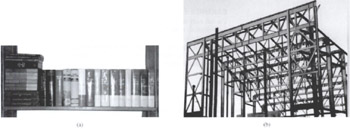
A beam is any long structural member on which loads act perpendicular to the longitudinal axis. The bookshelf in Figure 6.1a can be modeled as a beam because the length is much greater than its width or thickness, and the weight of the books is perpendicular to the length of the shelf. The horizontal members in the frame of the building in Figure 6.1b can be modeled as beams that transmit the weight of the roof to the vertical columns and are braced for stiffness with axial members. The mast of a ship, the pole of a sign post, the frame of a car, the bulkheads in an aircraft, and the plank of a seesaw are among the countless examples of beams. In most cases the bending loads are coupled to torsional and axial loads. These combined loadings will be considered in Chapter 10. Stresses in symmetric bending are considered in this chapter, whereas the deflection of the beam will be discussed in Chapter 7.


Figure 6.1: Examples of beams.

The simplest theory for symmetric bending of beams will be developed rigorously, following the logic described in Figure 3.15, but subject to the limitations described in Section 3.13.

The two major learning objectives are:

  1. Understand the theory, its limitations, and its applications for a strengthbased design and analysis of symmetric bending of beams.

  2. Develop the discipline to visualize the normal and shear stresses in the symmetric bending of beams.

6.1 PRELUDE TO THEORY

Several numerical examples are solved...

UNLIMITED FREE
ACCESS
TO THE WORLD'S BEST IDEAS

SUBMIT
Already a GlobalSpec user? Log in.

This is embarrasing...

An error occurred while processing the form. Please try again in a few minutes.

Customize Your GlobalSpec Experience

Category: Beams, Joists, and Wall Studs
Finish!
Privacy Policy

This is embarrasing...

An error occurred while processing the form. Please try again in a few minutes.