Mobile Communications Engineering: Theory and Applications, Second Edition
Chapter 2: Statistical Communications Theory

2.1 The Statistical Approach

Statistical communications theory is a powerful tool for solving complex problems that are too complicated to solve by ordinary means. These complications arise when there are too many variations or too many variables and when the mobile-radio phenomena are too complicated to describe in simple terms. Statistical communications theory can be used to analyze various types of natural phenomena. For example, when the parameters for describing a medium are random in nature, there are always laws for defining them. The natural laws do not provide deterministic answers but render results that can be subjected to statistical evaluation. As an example, a resultant signal for N incoming waves received by a mobile unit in motion has already been expressed in Eq. (1.20) but can also be written in another way:

(2.1)

where

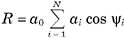
(2.2)

and

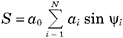
(2.3)

as can be deduced from Eq. (1.21).

The relationships between the parameters of Eq. (1.20) and Eq. (2.1) are as follows:

(2.4)
(2.5)

In general, the expressions for a resultant signal of N scattered waves, Eqs. (1.20) through (1.22), are used primarily to study the amplitude and phase of the baseband signal output, whereas Eqs. (2.1) through (2.3) are used primarily to study the natural characteristics of radio waves arriving at the RF input to the receiver.

The values R and S of Eqs. (2.2) and (2.3) separate the sum value of individual waves into real and imaginary parts, where a i is the amplitude and ?

UNLIMITED FREE
ACCESS
TO THE WORLD'S BEST IDEAS

SUBMIT
Already a GlobalSpec user? Log in.

This is embarrasing...

An error occurred while processing the form. Please try again in a few minutes.

Customize Your GlobalSpec Experience

Category: RF Power Detectors
Finish!
Privacy Policy

This is embarrasing...

An error occurred while processing the form. Please try again in a few minutes.