Mobile Communications Engineering: Theory and Applications, Second Edition
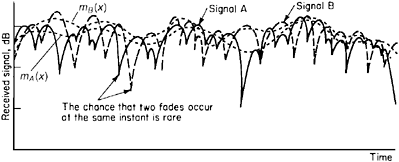
A diversity scheme is a method that is used to develop information from several signals transmitted over independently fading paths. The objective is to combine the multiple signals and reduce the effect of excessively deep fades. The combining of signals will be described in the next chapter. Diversity schemes can minimize the effects of fading, since deep fades seldom occur simultaneously during the same time intervals on two or more paths. Two uncorrelated fading signals received via independently fading paths are shown in Fig. 9.1.
Since the chance of having two deep fades from two uncorrelated signals at any instant is rare, the effect of the fades can be reduced by combining them. There are two general types of diversity schemes. One is called the "macroscopic diversity scheme" and the other is the "microscopic diversity scheme." The macroscopic diversity scheme is used for combining two or more long-term lognormal signals, which are obtained via independently fading paths received from two or more different antennas at different base-station sites. The microscopic diversity scheme is used for combining two or more short-term Rayleigh signals, which are obtained via independently fading paths received from two or more different antennas but only at one receiving cosite.
As was discussed previously in Chaps. 3 through 5, the long-term log-normal fading which the mobile-radio signal undergoes in a shadow region causes the average power to drop...