Mobile Communications Engineering: Theory and Applications, Second Edition
In Chaps. 3 and 4, the effects of the natural environment on radio-wave propagation were described in some detail. Other factors associated with mobile-radio system RF design can also have a significant effect on radio-wave propagation. Such RF design factors include the type of antenna employed, the directivity characteristics of the antenna, and various field components of the transmitted energy, signal polarization, and gain factors.
To properly evaluate the effects of antenna design on mobile-radio propagation, it is first necessary to develop an expression for the amount of transmitted power received by the mobile unit. Since the typical environment of a mobile unit includes both natural and humanmade obstructions-i.e., trees, hills, buildings, structures, and other vehicles-the expression for the amount of transmitted power received by the mobile unit is quite different from that used to describe conventional line-of-sight propagation parameters.
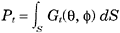
The power P t radiated by a base-station antenna is equal to the surface integral of the radiation pattern distributed over the surface of a large sphere with the base-station antenna located at its center. The radiated power P t can be expressed:
| (5.1) | |
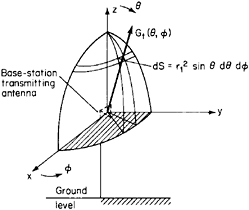
where S is the surface of a large sphere. Figure 5.1 illustrates the spherical-surface concept of a large sphere in the far field with a cen- trally located base-station transmitting antenna. With the coordinates illustrated in the figure, Eq. (5.1) may be written:
| (5.2) | |
where
| (5.3) | |
and