Mobile Communications Engineering: Theory and Applications, Second Edition
8.11: Spread Spectrum Modulation-Direct Sequence (DS) [27]

8.11 Spread Spectrum Modulation-Direct Sequence (DS) [27]

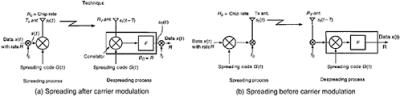
The spread spectrum can provide the redundancy of the message bits while in transmission. The two direct sequence techniques can be illustrated in Fig. 8.30. The first one is shown in Fig. 8.30(a). The data x( t) transmitted at a rate R b are modulated, first by carrier f 0 and then by a spreading code G( t) to form a DS signal s t( t) with a chip rate R c, which takes a DS bandwidth B ss. Then the DS signal s t( t - T), after a propagation time delay T, is received and goes through a correlator that consists of two functions: multiplier and averager. The correlator uses the same prestored spreading code G( t) to despread the DS signal. Then the despread signal x( t - T) is covered. The second DS technique is to spread first, then modulate, as shown in Fig. 8.30(b). These two DS techniques provide the same DS signal s t( t). The following analysis uses the technique from Fig. 8.30(a).


Figure 8.30: Basic spread-spectrum technique. Tx Ant.-transmitting antenna; Rv Ant.-receiving antenna.

Let x( t) be a data stream modulated by a binary phase shift keying (BPSK) so that

(8.145)

where x( t) = 1 and its data rate = R b . At the...

UNLIMITED FREE
ACCESS
TO THE WORLD'S BEST IDEAS

SUBMIT
Already a GlobalSpec user? Log in.

This is embarrasing...

An error occurred while processing the form. Please try again in a few minutes.

Customize Your GlobalSpec Experience

Category: Access Points
Finish!
Privacy Policy

This is embarrasing...

An error occurred while processing the form. Please try again in a few minutes.