Mobile Communications Engineering: Theory and Applications, Second Edition
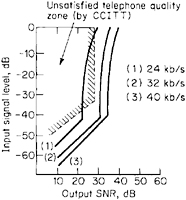
When digital modulation techniques are used, speech signals must be coded into a format suitable for digital transmission. This can be accomplished by using PCM, DPCM, and delta modulation [6, 7]. A digitally controlled companding scheme [8, 9] can be used to obtain a good telephone link with a bit rate of 32 kb/s, which appears to meet CCITT specifications. For bit rates as low as 20 kb/s, other types of modulation schemes have been reported that are effective in providing intelligible speech signals. Where companded delta modulation is used, a rate of 32 kb/s yields a baseband snr of at least 30 dB over a dynamic range of 45 dB. Figure 8.10 illustrates the snr for various bit rates and input signal levels [8]. Recently, using linear predictive coding (LPC) requires only 2.4 kb/s. The description of LPC is shown in Sec. 14.5.
Sampled speech data at a bit rate f s can be transmitted over a radio channel by either AM, PM, or FM. From the viewpoints of power economy and system simplicity, only two-level systems are considered. Also, the filter shaping is performed at the transmitter, whereas the receiving filter is used only for channel selection purposes.
There are five selection schemes that are worthy of discussion: (1) coherent binary AM (PSK), (2) FM with discrimination, (3) coherent FSK, (4) noncoherent FSK, and...