7.1 Random Variables Related to Mobile-Radio Signals
A signal s 0( t) received at the mobile unit can be expressed:
| (7.1) | 
|
The long-term-fading factor m( x) is extracted from s 0( t) and the resultant can be expressed:
| (7.2) | 
|
where r 0( t) and ?( t) are the envelope and phase terms, respectively. The characteristics of r 0( t) have been discussed in Chap. 6. The phase and time derivative of  , is the random FM that is described in this chapter.
Assume that a j( t) is the jth wave arrival, then s( t) represents the sum of all wave arrivals, as has been shown in Eq. (6.10):
| (7.3) | 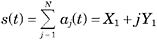
|
where X 1 and Y 1 are as defined in Eqs. (6.11) and (6.12), respectively.
Hence ? 1( t) can be defined:
| (7.4) | 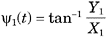
|
The terms X 1 and Y 1 of the signal s( t) are two independent Gaussian variables with zero mean and a variance of ? 2. This means that:
| (7.5) | 
|
and
| (7.6) | 
|
But when two signals s 1 = s( t) and s 2 = s( t + ?), expressed
| (7.7) | 
|
and
| (7.8) | 
|
are correlated, then E[ X 1 X 2] and E[ X 1 Y 2] are not necessarily zero. Consequently, it is first necessary to find the covariance...


 TABLE OF CONTENTS