Mobile Communications Engineering: Theory and Applications, Second Edition
8.2: FM for Mobile Radio

8.2 FM for Mobile Radio

Frequency modulation (FM) can improve the baseband signal-to-noise ratio without necessitating an increase in transmitting power. Also, FM can capture the signal from the interference even when the signal-to-interference ratio is small. Assume that a signal transmitted from a base station is

(8.1)

where A is a constant and ?( t) is defined:

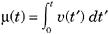
(8.2)

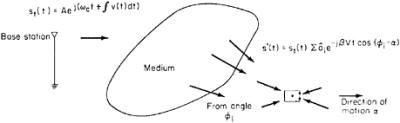
and ?( t ?) is the actual message. Then the received signal at the mobile-unit antenna (see Fig. 8.1), as shown in Eq. (6.8), can be expressed:


Figure 8.1: Received signal at the mobile antenna.
(8.3)

The term s ?( t) can also be expressed:

(8.4)

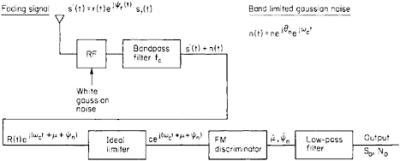
The relationships for the parameters shown in Eqs. (8.3) and (8.4) were previously expressed in Eq. (1.20). On the assumption that Fig. 8.2 is a block diagram of an FM receiver typically used in a mobile-radio unit, then the signal at the input of the IF filter is


Figure 8.2: Block diagram of an FM receiver.
(8.5)

where

(8.6)

Nonfading case

For a nonfading case, let Q( t) = 1 in Eq. (8.5). Upon reception by an FM system, the baseband signal-to-noise ratio of this signal can be improved without increasing the transmitted power, but rather by increasing the frequency deviation of the modulation and consequently increasing the IF bandwidth. The nonfading case can be analyzed for two situations: (1) signal present and (2) no signal present.

Signal present. The special case...

UNLIMITED FREE
ACCESS
TO THE WORLD'S BEST IDEAS

SUBMIT
Already a GlobalSpec user? Log in.

This is embarrasing...

An error occurred while processing the form. Please try again in a few minutes.

Customize Your GlobalSpec Experience

Category: RF Receivers
Finish!
Privacy Policy

This is embarrasing...

An error occurred while processing the form. Please try again in a few minutes.