Partial Differential Equations: Analytical and Numerical Methods

Emphasizing techniques over theory, this book focuses its discourse mainly on physical and mathematical derivations of Laplace, wave, and heat equations.
 TABLE OF CONTENTS
 The solution techniques presented in this book can be described by analogy to techniques for solving

where A is an n n matrix ( A ? R n n) and x and b are n-vectors ( x,b ? R n). Recall that such a matrix-vector equation represents the following system of n linear equations in the n unknowns x 1, x 2, , x n:
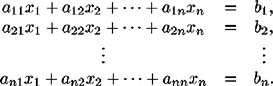
Before we discuss methods for solving differential equations, we review the fundamental facts about systems of linear (algebraic) equations.
To fully appreciate the point of view taken in this book, it is necessary to understand the equation Ax = b not just as a system of linear equations, but as a finitedimensional linear operator equation. In other words, we must view the matrix A as defining an operator (or mapping, or simply function) from R n to R n via matrix multiplication: A maps x ? R n to y = Ax ? R n. (More generally, if A is not square, say A ? R m n, then A defines a mapping from R n to R m, since Ax ? R m for each x ? R n.)
The following language is useful in discussing operator equations.
Let X and