Partial Differential Equations: Analytical and Numerical Methods

Emphasizing techniques over theory, this book focuses its discourse mainly on physical and mathematical derivations of Laplace, wave, and heat equations.
 TABLE OF CONTENTS
 | 1. | Let  Compute, by hand, the eigenvalues and eigenvectors of A, and use them to solve Ax = b for x (use the "spectral method"). |
|
| 2. | Repeat Exercise 1 for  |
|
| 3. | Repeat Exercise 1 for 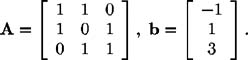 |
|
| 4. | Repeat Exercise 1 for 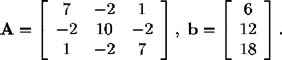 |
|
| 5. | Let A ? R n n be symmetric, and suppose the eigenvalues and (orthonormal) eigenvectors of A are already known. How many arithmetic operations are required to solve Ax = b using the spectral method? |
|
| 6. | A symmetric matrix A ? R n n is called positive definite if  Use the spectral theorem to show that A is positive definite if and only if all of the eigenvalues of A are positive. |
|
| 7. | Let L be the n n matrix defined by the condition that 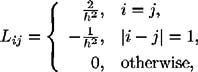 where h = 1/( n + 1). For example, with n = 5, 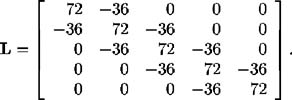
|