Partial Differential Equations: Analytical and Numerical Methods

Emphasizing techniques over theory, this book focuses its discourse mainly on physical and mathematical derivations of Laplace, wave, and heat equations.
 TABLE OF CONTENTS
 We now turn our attention to time-dependent problems, still restricting ourselves to problems in one spatial dimension. Since both time ( t) and space ( x) are independent variables, the differential equations will be PDEs, and we will need initial conditions as well as boundary conditions.
We begin with the heat equation,

This PDE models the temperature distribution u( x, t) in a bar (see Section 2.1) or the concentration u( x, t) of a chemical in solution (see Section 2.1.3). Since the first time derivative of the unknown appears in the equation, we need a single initial condition.
Our first model problem will be the following initial-boundary value problem (IBVP):
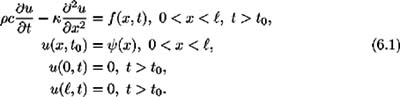
We apply the Fourier series method first and then turn to the finite element method. We close the chapter with a look at Green's functions for this and related problems. Along the way we will introduce new combinations of boundary conditions.
We now solve (6.1) using Fourier series. Since the unknown u( x, t) is a function of both time and space, it can be represented as a Fourier sine series in which the Fourier coefficients depend on t. In other words, for each t, we have a Fourier sine series representation of u( x, t) (regarded as a function of x). The series takes the form

The function u will then automatically satisfy the boundary...