Partial Differential Equations: Analytical and Numerical Methods

Emphasizing techniques over theory, this book focuses its discourse mainly on physical and mathematical derivations of Laplace, wave, and heat equations.
 TABLE OF CONTENTS
 Our first examples of partial differential equations (PDEs) will arise in the study of static (equilibrium) phenomena in mechanics and heat flow. To make our introduction to the subject as simple as possible, we begin with one-dimensional examples; that is, all of the variation is assumed to occur in one spatial direction. Since the phenomena are static, time is not involved, and the single spatial variable is the only independent variable. Therefore, the "PDEs" are actually ODEs! Nevertheless, the techniques we develop for the one-dimensional problems generalize to real PDEs.
As mentioned in Chapter 3, the solution methods presented in this book bear strong resemblance, at least in spirit, to methods useful for solving a linear system of the form Ax = b. In the exercises and examples of Chapter 3, we showed some of the similarities between linear systems and linear BVPs. We now review these similarities, and explain the analogy further.
We will use the equilibrium displacement u of a sagging string as our first example. In Section 2.3, we showed that u satisfies the BVP
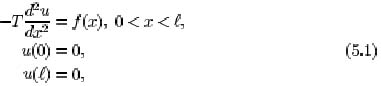
where T is the tension in the string and f is an external force density (in units of force per length).
If A ? R m n, then A defines an operator mapping R n into R m, and given b ? R m, we can ask the following questions:
Is there an