Partial Differential Equations: Analytical and Numerical Methods

Emphasizing techniques over theory, this book focuses its discourse mainly on physical and mathematical derivations of Laplace, wave, and heat equations.
 TABLE OF CONTENTS
 Let A ? R n n be symmetric, and suppose A has an eigenvalue ? of (algebraic) multiplicity k (meaning that ? is a root of multiplicity k of the characteristic polynomial of A). Then A has k linearly independent eigenvectors corresponding to ?.
| Proof. | We argue by induction on n. The result holds trivially for n = 1. We assume it holds for symmetric ( n ? 1) ( n ? 1) matrices, and suppose A ? R n n is symmetric and has an eigenvalue ? of (algebraic) multiplicity k. There exists x 1 ? 0 such that Ax 1 = ? x 1. We can assume that x 1 = 1 (since x 1/ x 1 is also an eigenvector of A), and we extend x 1 to an orthonormal basis { x 1, x 2, , x n}. Then 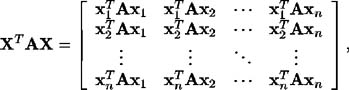 where X ? R n n is defined by X = [ x 1 x 2 x n]. We have  and 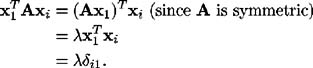 (The symbol ? ij is 1 if i = j and 0 if i ? j.) Therefore, 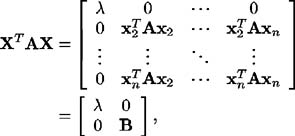 where B ? R (n ?1) (n ?1) is defined by  The matrix B is symmetric. Also,  since X T = X ? |