Partial Differential Equations: Analytical and Numerical Methods

Emphasizing techniques over theory, this book focuses its discourse mainly on physical and mathematical derivations of Laplace, wave, and heat equations.
 TABLE OF CONTENTS
 The method of shifting the data can be used to transform an inhomogeneous Dirichlet problem to a homogeneous Dirichlet problem. This technique works just as it did for a one-dimensional problem, although in two dimensions it is more difficult to find a function satisfying the boundary conditions. We consider the BVP
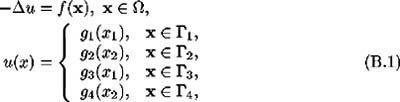
where ? is the rectangle defined in (8.10) and ?? = ? 1 ? ? 2 ? ? 3 ? ? 4, as in (8.13). We will assume that the boundary data are continuous, so

Suppose we find a function p defined on ? and satisfying p( x) = g( x) for all x ? ??. We then define v = u ? p and note that

and

(since p satisfies the same Dirichlet conditions that u is to satisfy). We can then solve
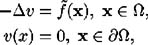
where

The result will be a rapidly converging series for v, and then u will be given by u = v + p.
We now describe a method (admittedly rather tedious) for computing a function p that satisfies the given Dirichlet conditions. We first note that there is a polynomial of the form

which assumes the desired boundary values at the corners:
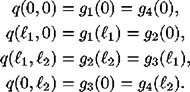
A direct calculation shows that
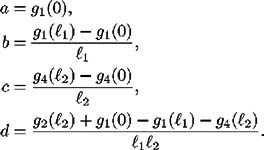
We then define
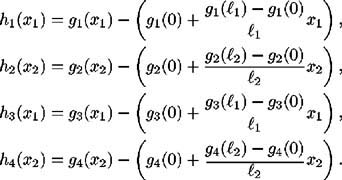
We have thus replaced each g i by a function h i which differs from g