Partial Differential Equations: Analytical and Numerical Methods

Emphasizing techniques over theory, this book focuses its discourse mainly on physical and mathematical derivations of Laplace, wave, and heat equations.
 TABLE OF CONTENTS
 | 1. |
|
|
| 2. | Is 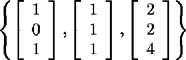 a basis for R 3? (Hint: As explained in the last paragraphs of this section, the three given vectors form a basis for R n if and only if Ax = b has a unique solution for every b ? R n, where A is the 3x3 matrix whose columns are the three given vectors.) |
|
| 3. | Is 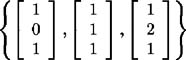 a basis for R 3? (See the hint for the previous exercise.) |
|
| 4. | Show that  is a basis for |
|
| 5. | Show that { L 1, L 2, L 3}, defined in Example3.28, is a basis for  holds for every |
|
| 6. | Let V be the space of all continuous, complex-valued functions defined on the real line:  Define W to be the subspace of V spanned by |