Partial Differential Equations: Analytical and Numerical Methods

Emphasizing techniques over theory, this book focuses its discourse mainly on physical and mathematical derivations of Laplace, wave, and heat equations.
 TABLE OF CONTENTS
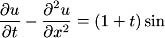
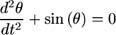
 | 1. | Classify each of the following differential equations according to the categories described in this chapter (ODE or PDE, linear or nonlinear, etc.): |
|
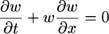
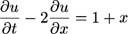
| 2. | Repeat Exercise 1 for the following equations: |
|
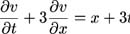
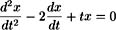
| 3. | Repeat Exercise 1 for the following equations: |
|
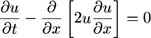
| 4. | Repeat Exercise 1 for the following equations: |
|
| 5. | Determine whether each of the functions below is a solution of the corresponding differential equation in Exercise 1: |
|
| 6. | Determine whether each of the functions below is a solution of the corresponding differential equation in Exercise 2: |
|
| 7. | Find a function f( t) so that u( t) = tsin ( t) is a solution of the ODE 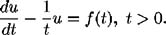 Is there only one such function f? Why or why not? |
|
| 8. | Is there a constant f such that u( t) = e t is a solution of the ODE 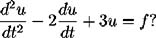 |
|
| 9. | Suppose u is a nonzero solution of a linear, homogeneous differential equation. What is another nonzero solution? |
|
| 10. | Suppose u is a solution of  and v is a (nonzero) solution of  Explain how to produce infinitely many different solutions of (1.9) |
|
Answers
| 1. |
|
| 2. | |
| 3. |
|
| 4. | |
| 5. |
|
| 6. | |
| 7. | There is only one such f: f( t) = tcos ( |