Partial Differential Equations: Analytical and Numerical Methods

Emphasizing techniques over theory, this book focuses its discourse mainly on physical and mathematical derivations of Laplace, wave, and heat equations.
 TABLE OF CONTENTS
 We now treat the one-dimensional wave equation, which models the transverse vibrations of an elastic string or the longitudinal vibrations of a metal bar. We will concentrate on modeling a homogeneous medium, in which case the wave equation takes the form
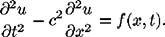
Our first order of business will be to understand the meaning of the parameter c. We then derive Fourier series and finite element methods for solving the wave equation. It is straightforward to extend the finite element methods to handle heterogeneous media (nonconstant coefficients in the PDE).
We begin our study of the wave equation by supposing that there are no boundaries that the wave equation holds for ?? < x < ?. Although this may not seem to be a very realistic problem, it will provide some useful information about wave motion.
We therefore consider the IVP
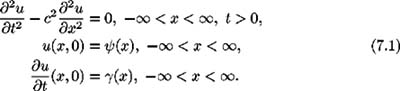
(To simplify the algebra that follows, we assume in this section that the initial time is t 0 = 0.) With a little cleverness, it is possible to derive an explicit formula for the solution in terms of the initial conditions ?( x) and ?( x). The key point in deriving this formula is to notice that the wave operator

can be factored:

For example,
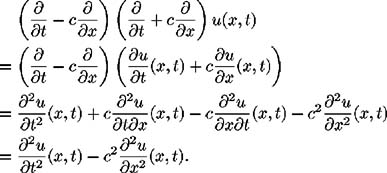
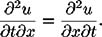
The mixed partial derivatives cancel because, according to a theorem of calculus, if the second derivatives of a function u( x, t) are continuous, then
It follows...