Power Amplifier Design: A Collection from Applied Microwave & Wireless

With contributions from more than 20 experts, these articles present valuable resources for power amplifier linarization, measuring, modeling and distortion.
 TABLE OF CONTENTS
By Frank Amoroso and Robert A.Monzingo
From APPLIED MICROWAVE & WIRELESS, VOL. 10, NO. 8, OCTOBER 1998
This article introduces a method to suppress the regrowth of the power spectral sidelobes of an OQPSK data stream by predistorting the modulated signal prior to soft-saturation power amplification. The heart of the scheme is the adaptive cancellation of the para signal, which is defined as the product of two input signal characteristics: the fractional carrier amplitude ripple and the phase modulation. The predistortion operation augments the fractional ripple at the amplifier input, thus counteracting the inverse effect within the soft saturating amplifier. This scheme is remarkably simple, automatically adapts to changing amplifier characteristics, and may be introduced as an applique in existing transmitters. By employing the predistorter, the transmitter can operate at a higher power level in the amplifier than before, leaving the desired aspects of the transmitted signal intact while still meeting stringent specifications on spectral containment.
With reference to Figure 1, the signal predistortion scheme described here is an applique operating at baseband, intermediate frequency (IF) or radio frequency (RF), inserted somewhere between either:
The data modulator whose output is the spectrally contained digital data signal, or
The input to the RF power amplifier, which is soft-saturating.
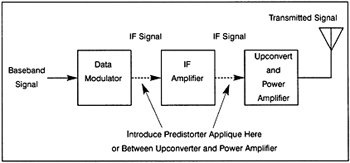
The purpose of the scheme is to predistort the modulated signal so the regrowth of power spectral sidelobes at the power amplifier output is suppressed even though the power...