Power Amplifier Design: A Collection from Applied Microwave & Wireless

With contributions from more than 20 experts, these articles present valuable resources for power amplifier linarization, measuring, modeling and distortion.
 TABLE OF CONTENTS
 The power gain is usually the parameter most limited by the frequency, since the devices normally are operated at the frequency-limited portion of the characteristics with a (theoretical) 10 dB/decade degradation.
The gain at RF can be described by the following relationship [3]:
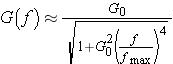
where G 0 is the zero-frequency gain ( ? or h FE) and f max is the maximum oscillation frequency, or the frequency where the power gain is equal to 1.
A plot of h FE versus G is shown in Figure 3 for different f max values at f=1 GHz. From this plot it can be concluded that a high f max and a not too low ? are detrimental for a good RF power gain. If ? is higher than required for a constant RF gain, the device will be sensitive to parasitic oscillations, and will have a decreased BV CEO. High ? also usually means high base resistance, which will lower the f max and consequently the RF power gain. An approximate expression for f max is:
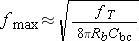
where f T is the transition frequency, (or the frequency where the current gain is equal to 1), R b is the base resistance and C bc is the collector-base capacitance. f T is a function of delay and charge times in the vertical C/B/E structure of the transistor. It is dominated by the base...