Practical MMIC Design

Filled with real-world design techniques and rules of thumb, this practical resource offers professionals a unique look into the day-to-day practices of MMIC production and the economics associated with it.
 TABLE OF CONTENTS
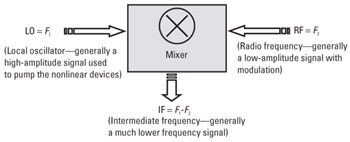
 Mixers are required in heterodyne transmit and receive systems where low-frequency signals are up-converted to higher RF frequencies for transmission, then down-converted back to lower frequencies when received. This unique characteristic of frequency conversion is the primary function of the mixer and is shown schematically in Figure 5.115. Mixers are nonlinear devices that use their nonlinear characteristics to convert one frequency to another while maintaining any applied amplitude, frequency, or phase modulation. The precise nature of the nonlinearity is not necessarily important as all nonlinearities will create the mixing function, but specific nonlinear characteristics are more efficient at converting frequencies in certain applications. Further information on mixers can be found in [113].
The basic principles of frequency conversion can be understood by reconsidering the analysis of nonlinear elements discussed in Section 5.3.3.1. It was shown for the case of the nonlinear resistor in Figure 5.73, whose resistance ( R) is an arbitrary (nonlinear) function of the applied voltage ( V), that whatever shapes the curve takes, the current (I) can be expressed as a polynomial expansion of the applied voltage as given in (5.32).
| (5.32) |  |
If the applied signal voltage now contains two frequencies, the LO and the RF, and each is a sinusoidal signal with amplitude A and angular frequency ?, the expression for the applied voltage is given in (5.33):
| (5.33) |  |
Equation 5.33 may be substituted into (5.32) to give a new expression for the current.