Practical MMIC Design

Filled with real-world design techniques and rules of thumb, this practical resource offers professionals a unique look into the day-to-day practices of MMIC production and the economics associated with it.
 TABLE OF CONTENTS
 Digital circuits are primarily the domain of silicon CMOS circuits, but with the development of HBT MMIC processes capable of millimeter-wave-frequency performance, more and more circuits with digital applications are being designed on semiconductors other than silicon. The main examples of this are prescalers, log amplifiers, and Darlington amplifiers.
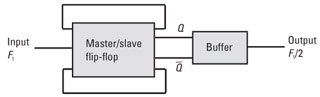
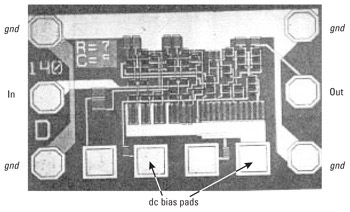
Prescalers are used in frequency-counter circuits to bring the frequency down to a level that can be handled by standard silicon signal-processing circuits. For example, a divide-by-two prescaler schematic is shown in Figure 5.144, where the output from a master-slave flip-flop is fed back to its input so that it only changes every second cycle. Virtually the same low-frequency silicon circuit designs for fixed and variable modulus dividers can be reproduced at much higher frequencies using HBT MMIC processes. Examples of prescaler MMICs [153, 154] are in the literature, and a 17-GHz HBT divide-by-two prescaler MMIC is shown in Figure 5.145.
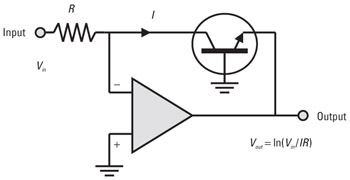
The output voltage from a logarithmic amplifier is a log function of input voltage [155]. These amplifiers are used in electronic warfare applications to detect very low and very high amplitude signals. A typical MMIC design [156] would consist of an HBT operational amplifier with nonlinear feedback from a common-base HBT, as shown in Figure 5.146.
In Darlington pairs of bipolar transistors, the amplified current from the first...