Practical MMIC Design

Filled with real-world design techniques and rules of thumb, this practical resource offers professionals a unique look into the day-to-day practices of MMIC production and the economics associated with it.
 TABLE OF CONTENTS
 The type of passive elements, whose design principles are described in this section, are those that generally form subcircuits within larger MMICs but could in themselves form stand-alone circuits. For example, baluns are often used in mixers; splitters and combiners are often used in power amplifiers; and all of them may be used in transmit and receive (Tx/Rx) chips. They form an important part of the practical MMIC designers' toolbox because, not being based on the active devices, they tend to be less sensitive to processing variations and, hence, a more reproducible component.
Designers can utilize the distributed nature of the transmission lines to transform known impedances, such as short and open circuits, into a wide range of shunt impedances, as discussed in Section 5.1.6. When used as matching elements, they are known as open and short circuit stubs. The open circuits are formed from open-ended transmission lines, and microstrip short circuits are formed from through-substrate vias at low frequencies and from radial stubs at millimeter-wave frequencies. One-quarter-wavelength open circuit and short circuit stubs are often used in multiplier circuits because they have opposite effects on the signals at f 0 and 2 f 0, as shown in Figure 5.23.
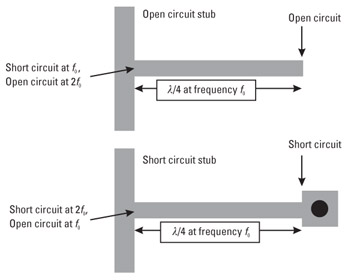
The open circuit stub transforms the open circuit to a short circuit where it meets the through transmission line. This is a useful filter circuit for multipliers because it shorts...