Protection of Electrical Networks
Suitable for engineers, technicians, designers and operators working with electrical networks, this book discusses network structures and grounding systems, as well as problems that can occur in networks.
 TABLE OF CONTENTS
 In any medium or low voltage three-phase system there are three single voltages measured between each phase and a common point called the "neutral point".
In actual fact, the neutral is the common point of three star-connected windings (see Figure 2-1).
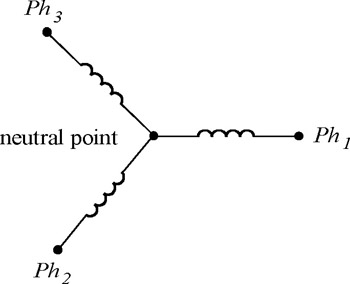
The neutral may or may not be accessible or distributed. Except in specific cases (e.g. networks in North America and Australia), the neutral is not distributed at medium voltage. However, the neutral is very often distributed at low voltage.
In a medium or low voltage installation, the neutral may or may not be earthed. This is why we talk about the earthing system.
The neutral may be directly connected to earth or connected through a resistor or a reactor. In the first case, we say that the neutral is directly earthed and in the second case we say that it is impedance-earthed.
When a connection has not been made between the neutral point and earth, we say that the neutral is unearthed.
In a network, the earthing system plays a very important role. When an insulation fault occurs or a phase is accidentally earthed, the values taken by the fault currents, the touch voltages and overvoltages are closely linked to the type of neutral earthing connection.
A directly earthed neutral strongly limits overvoltages but it causes very high fault currents, whereas an unearthed neutral limits fault currents to very low values but encourages the occurrence of...