Protection of Electrical Networks
Suitable for engineers, technicians, designers and operators working with electrical networks, this book discusses network structures and grounding systems, as well as problems that can occur in networks.
 TABLE OF CONTENTS
 We shall first of all study the transient currents that occur during transformer switching and the value of the LV short-circuit current detected by the HV side for a delta-star transformer. We shall then study the protection of transformers.
When the transformer is energized, a transient overcurrent is created, which depends on the moment that the voltage is applied and the remanent induction of the magnetic circuit.
The asymmetry and the current value are maximum when the transformer is energized, at the moment the voltage reaches zero, and when the remanent induction on the same phase is maximum.
The overcurrent is due to the saturation of the magnetic circuit, which causes a very high magnetizing current.
It is shown that: 
B max : maximum induction reached
B n: nominal induction
B r: remanent induction which may reach 0.8 B n
This overcurrent is referred to as an inrush current.
The inrush current thus develops as shown in Figure 10-21.

The peak value of the inrush current is damped according to an exponential law:
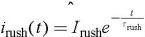
rush : peak value of the current in relation to time
rush : maximum peak value, i.e. the first peak
? rush : damping time constant
The maximum peak value rush is defined in relation to the nominal r.m.s. current of the transformer:

Tables 10-3 and 10-4 give the maximum values of the...