Protection of Electrical Networks
Suitable for engineers, technicians, designers and operators working with electrical networks, this book discusses network structures and grounding systems, as well as problems that can occur in networks.
 TABLE OF CONTENTS
 Differences between AC and DC installations
Although the basic design principles in each case are the same, there are nevertheless differences in:
the fault current calculations (short-circuit or insulation fault);
the choice of protective devices to be installed which must be suitable for the direct current.
Storage battery (see Figure 10-49)
When a short-circuit occurs at its terminals, a storage battery will pass a current according to Ohm's law:

V b: maximum discharge voltage (fully charged battery)
R i: internal resistance of the entire battery (value generally given by the manufacturer in relation to its ampere-hour capacity)
When the internal resistance is not known, the following approximate formula can be used:

where C is the capacity of the battery expressed in ampere-hours and k is a coefficient close to 10, and always less than 20.
What is the short-circuit current at the terminals of a battery with the following characteristics:
capacity: 500 Ah
maximum discharge voltage: 242 V (110 2.2 V elements)
discharge current: 300 A
autonomy: 1/2 hour
internal resistance: 0.5 m ? per element
The following is calculated:
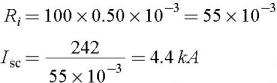
As the calculation shows, the short-circuit currents are relatively low.
Direct current generator (see Figure 10-50)
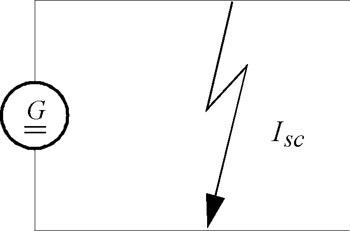
If V g designates the electro-motive force of the generator and R i its internal resistance, then:

In the absence of specific indications and for...