Protection of Electrical Networks

Suitable for engineers, technicians, designers and operators working with electrical networks, this book discusses network structures and grounding systems, as well as problems that can occur in networks.
 TABLE OF CONTENTS
 The equivalent upstream network diagram during a solid short circuit is shown in Figure A-1.

It is assumed that at the moment the short circuit occurs, the voltage phase is ?.
The current i( t) is determined by the following differential equation:
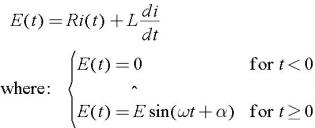
We shall solve this differential equation using Laplace transforms.
As a Laplace transform, the differential equation becomes:

as it is assumed that the current is zero (negligible) before the fault, then i( t =0) = 0.
The Laplace transform tables give us:
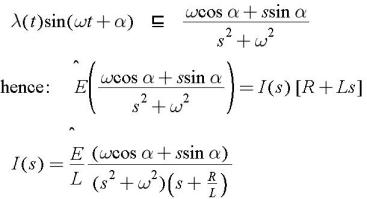
To reverse the Laplace transform I ( s), it must be written differently.
We know that we can write I( s) as:

We shall thus look for the value of coefficients A, B and C.
Search for coefficient C
By multiplying the two terms of the equation by  , and by taking
  we obtain:
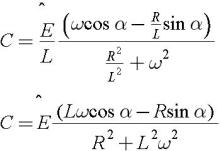
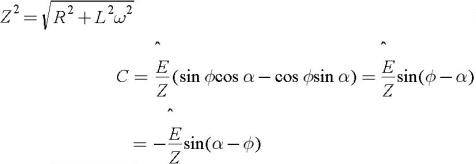
Let us take: Z 2 = R 2 + L 2 ? 2
If ? is the network's natural phase displacement, we have:  and
and 

Search for coefficient A
If we make s stretch to infinity, we obtain the following equation:
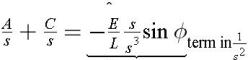
hence: 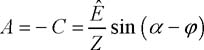
Search for coefficient B
If we make s stretch to 0, we obtain the following equation:
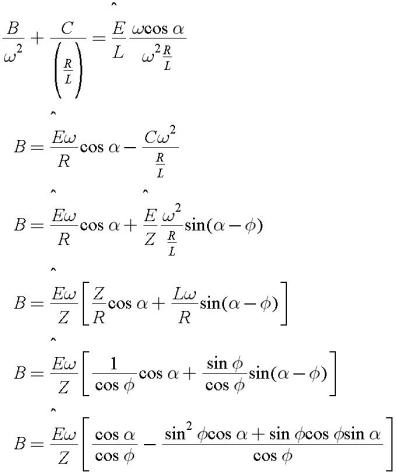
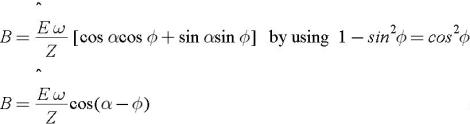
We can thus write I ( s) as follows:

Using the Laplace transform tables, we can deduce i( t):