Protection of Electrical Networks
Suitable for engineers, technicians, designers and operators working with electrical networks, this book discusses network structures and grounding systems, as well as problems that can occur in networks.
 TABLE OF CONTENTS
 Capacitor element: Device made of two electrodes separated by a dielectric (see Figure 10-40).
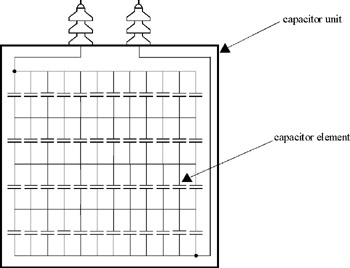
Capacitor unit: Set of capacitor elements placed in the same enclosure and linked to outlet terminals (see Figure 10-40).
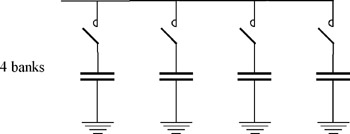
Capacitor bank (or bank): Set of capacitor units connected so that they can be controlled by the same switching device.
Switched steps bank: Combination of several so-called "switched steps" banks, each bank being separately controlled (see Figure 10-41).
Capacitor bank energization causes current and voltage transient operating states.
An overcurrent occurs, the amplitude and frequency of which depend on the specifications of the upstream network and the number of capacitor banks.
The upstream network is considered to be a pure inductance L up such that:

where:
| S sc | : short-circuit power at the capacitor connection point |
| U n | : nominal phase-to-phase voltage |
| I sc | : symmetrical three-phase short-circuit current at the capacitor connection point |
The connection linking the switching device (contactor, circuit-breaker or switch) to the capacitor bank is considered to be a pure inductance of 0.5 ? H/m, which corresponds to an impedance of 0.15 ?/ km (see section 4.2.1.4).
| Note | we can consider that resistances are negligible in relation to inductances due to the high frequency of transient currents (see examples 1 and 2). |
Fixed bank
The equivalent single-phase diagram...