Quantitative Measurements for Logistics

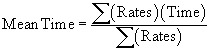
The assignment of mean (average) times to lower indentured assemblies given the top assembly mean time is accomplished by using an allocation process. The top assembly mean time must first be converted to its appropriate rate by finding the reciprocal of the mean. A percentage is then assigned to each lower indentured assembly based upon available information like historical data on similar equipment, supplier data, complexity factors, or design data. Multiplying the assigned percentages by the top assembly rate will yield rates for each of the lower indentured assemblies. These rates may then be readily converted to mean times by finding the reciprocal of each individual rate. The basic Mean Time formula is
Example (1):
A new system with three Shop Replacable Units (SRUs) / Shop Replacable Assemblies (SRAs) was estimated to have a Mean Time Between Failure (MTBF) of 300 hours. Each SRU/SRA has the complexity relationships as shown. The new MTBF(s) is/are
Example Solution:
| SRU/SRA | Complexity Factor | Percent (%) | SRU/SRA % of 1/ ? | MTBF (1/ ? .) |
|---|---|---|---|---|
| A: | 1.0 | 22.2% | 0.000740 | = 1,350 hours |
| B: | 3.0 | 66.7% | 0.002223 | = 450 hours |
| C: | 0.5 | 11.1% | 0.000370 | = 2,700 hours |
| Totals = | 4.5 | 100.0% | [0.003333] | [300 hours] |
In this example, the complexity factors were all relative to SRU/SRA-(A). SRU/SRA-(B) was three times (3 ) as complex as SRU/SRA-(A), and SRU/SRA-(C) was half (0.5) as complex as SRU/SRA-(A). Complexity factors may be assigned on the basis of number of components; however, if some component is...